
Credentialing And Payer Enrollment
Credentialing Services For Mental Health Providers
Our credentialing services for mental health providers take therapists, psychologists, PMHNPs and psychiatrists through commercial payers, Medicare and Medicaid to a written effective date, under your own Tax ID.
See PricingWe work with every major commercial insurer, nationwide. That includes UnitedHealthcare/Optum, Aetna, Cigna/Evernorth, Anthem/Elevance, your state’s Blue Cross Blue Shield plan, Humana and regional plans. You pick the panels. Every credentialing package includes a review of your CAQH profile with you, so it matches what we send each payer. You complete and attest your own CAQH profile and sign any paper application a payer requires.
Medicaid changes at the state line. Commercial carriers mostly follow your license, so one contract can reach every state you’re licensed in. Medicaid doesn’t work that way. Each state runs its own program and enrollment system, with its own rules about who you contract with after you enroll. See credentialing and payer enrollment by state for all 50 states and DC.
What We Manage
Behavioral Health Credentialing, Managed Through The Effective Date.
From CAQH to approved panels, we track every enrollment in one place, so nothing sits waiting on a step nobody owns.
CAQH Audit
We audit your CAQH/DataSpring profile with you so it matches what we send each payer. While we’re working your applications, we track every attestation due date. Attestation itself is yours: CAQH requires the provider to do it.
Payer Panel Applications
We send commercial, Medicare, Medicaid and managed behavioral health applications complete, then follow each one through the payer’s queue.
Provider Readiness
We check that the license, DEA registration and malpractice coverage are current, along with the NPI and group affiliation, before a provider bills.
Three Ways To Get Credentialed
Comparing Credentialing Services For Mental Health Providers
Mental health providers get on insurance panels one of three ways. The difference that matters most is whose contracts you end up on.
| Option | Whose Contracts | How You Pay |
|---|---|---|
| Insurance platforms such as Headway or Alma | The platform’s. You join its payer contracts, and Alma says members are credentialed under Alma’s Tax ID. | Headway says joining is free and it keeps a small percentage of each session payment. Alma charges a monthly membership. |
| Credentialing-only services | Yours, under your own Tax ID. | A fee for the applications. Billing stays with your own staff or another company. |
| Done-for-you credentialing under your own Tax ID (us) | Yours. We follow every application to a written effective date. | A published package price per provider, from $500 per payer. |
Each of our four packages covers five commercial payers per provider. Payer Transition is $2,500, New Provider Credentialing is $3,000, Direct Payer Contracting is $3,500 and Therapist Credentialing is $2,500, or start with one payer from $500.
Headway and Alma details come from each company’s own provider pages (help.headway.co and helloalma.com), checked October 4, 2026.
Status Visibility
Know The Status Of Every Payer Enrollment
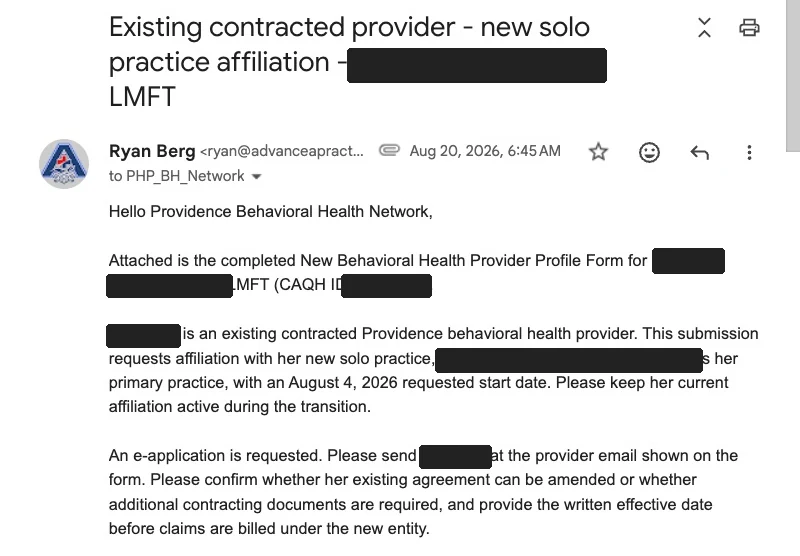
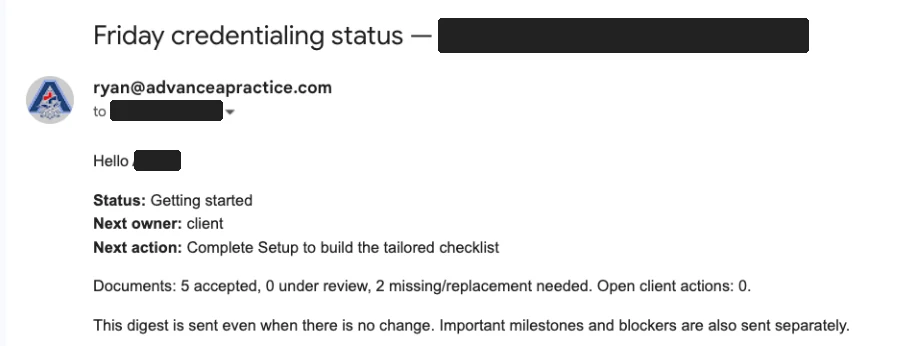
You get one tracked view of every provider’s credentialing. It replaces chasing payers and living in a spreadsheet, and it shows which panels are approved, which are pending and what happens next, so billing knows who’s ready before anyone’s put on the schedule.
Ask Practice Concierge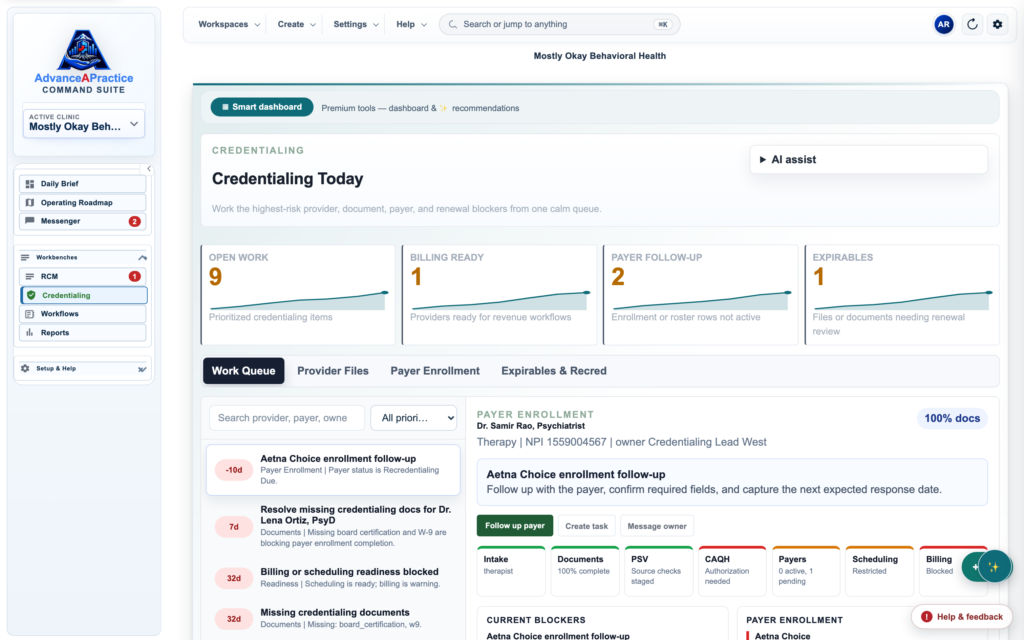
See Your Exact Credentialing Price.
Pick the work and the counts, and the itemized total shows before checkout. Each rate depends on what already exists, and how credentialing pricing works lays out every one. Provider and payer details come later, in secure onboarding.
Five payers run $2,500 to $3,500 per provider, paid in full or one payment per payer, up to five.
The more providers, the lower the price: 2 to 4 providers save 10%, 5 to 9 save 15% and 10 save 20%. The discount comes off the whole subtotal automatically. For example, 10 providers moving their contracts to a new practice or Tax ID pay $400 per payer instead of $500.
Payers six through nine are $350 each, or $1,500 for payers six through ten, and government enrollment is $500 per provider for each Medicare, Medicaid or Medicaid plan enrollment and can be bought on its own or with a package.
Your Itemized Total
Subtotal
Discount For Multiple Providers
Total
Checkout keeps this exact selection and total.
How It Works
Three Steps To A Clear, Documented Payer Status
Prep CAQH
We review your CAQH profile with you, gather documents and confirm your NPI, license, DEA and malpractice are current before any application goes out. You complete and attest the profile. We audit it first and tell you exactly what’s missing.
Prepare And Submit Each Payer Path
We send complete applications to every payer you picked at the same time, not one after another, so no panel waits on the one before it.
Document Each Status And Follow Up
We follow each application through the payer’s queue, answer every request for missing information, and push on any that stall until the payer confirms your in-network effective date.
How Credentialing Actually Moves
Most credentialing delays aren't caused by the application. They're caused by the steps on either side of it.
Confirm What Kind Of Enrollment This Is
Joining an existing group contract, moving panels to a new Tax ID, and opening a first network are three different requests. Getting that wrong costs weeks before anyone notices.
Build The File Before Submitting
License, DEA where applicable, malpractice naming the correct business, work history without gaps, and a current CAQH attestation. Payers reject on completeness long before they judge the provider.
Track Each Payer On Its Own Clock
Commercial plans, Medicare, Medicaid, and Medicaid managed care all run separate timelines and separate portals. We report status per payer, not as one average.
Get The Effective Date In Writing
Approved and effective aren't the same date. The effective date decides which claims get paid, so we ask for it in writing every time.
FAQ
Credentialing FAQs
How Long Does Provider Credentialing Take?
Most payers take 60 to 120 days from a complete application. Some take longer. The clock doesn’t really start until the application is complete, so the two things that move it most are gathering every document up front and following up regularly.
What Is CAQH And Do We Need It?
The DataSpring Provider Data Portal (formerly CAQH) is the universal credentialing database most commercial payers pull from. Providers have to keep the profile current and re-attest every 120 days, and an un-attested or outdated profile is one of the most common reasons credentialing stalls.
Can A Provider Bill Before Credentialing Is Complete?
As a rule, no. Most payers deny claims for visits before the provider’s in-network effective date. Some backdate to the application date, but many don’t, so hold those claims until the payer confirms enrollment.
Do You Track Attestation Dates?
While we’re working your applications, we track your attestation dates and tell you when your 120-day re-attestation is due. You attest it yourself, and we prepare any paper application for you to sign.
For PMHNPs
Run A Psychiatric Nurse Practitioner Practice?
We keep a separate hub for PMHNPs that covers billing and coding, credentialing and payer enrollment, and scope of practice by state. Explore the PMHNP hub or PMHNP credentialing.
Want the numbers first? See physician credentialing cost or PMHNP credentialing cost.
Know Where Your Providers Stand.
Launching, hiring or clearing a credentialing backlog? We start by finding out which payers have approved you and which applications are still pending or haven’t gone out yet. Then you get one price for the payers you actually need.