
Behavioral Health Credentialing
PMHNP Credentialing & Payer Enrollment
CAQH/DataSpring preparation, Medicare and Medicaid enrollment, and commercial payer applications for PMHNPs nationwide, prepared, submitted, followed up, and documented through each payer’s response.
Ask Practice Concierge See PricingWhat’s Included
Everything A PMHNP Needs To Bill In-Network
- Individual Type 1 NPI and psychiatric taxonomy, plus your practice’s Type 2 organizational NPI.
- DataSpring Provider Data Portal (formerly CAQH) information prepared and aligned; the provider personally completes each attestation. We never request the provider’s CAQH password.
- Medicare enrollment through PECOS (CMS-855I), including group reassignment (CMS-855R).
- State Medicaid enrollment, including states that require active Medicare first.
- Commercial panels: Aetna, Cigna, UnitedHealthcare, and Blue Cross Blue Shield.
- Collaborative-practice and scope-of-practice rules by state, mapped to you.
- Primary source verification and application follow-up on every payer.
- A recredentialing and revalidation calendar with owners and upcoming due dates.
Deadline Tracking
Getting In-Network Once Isn’t The End
Recredentialing runs at least every 36 months, CAQH re-attestation every 120 days, and Medicare and Medicaid revalidation every five years. We track each payer and due date in one view, flag upcoming deadlines, and keep the responsible person informed.
Ask Practice Concierge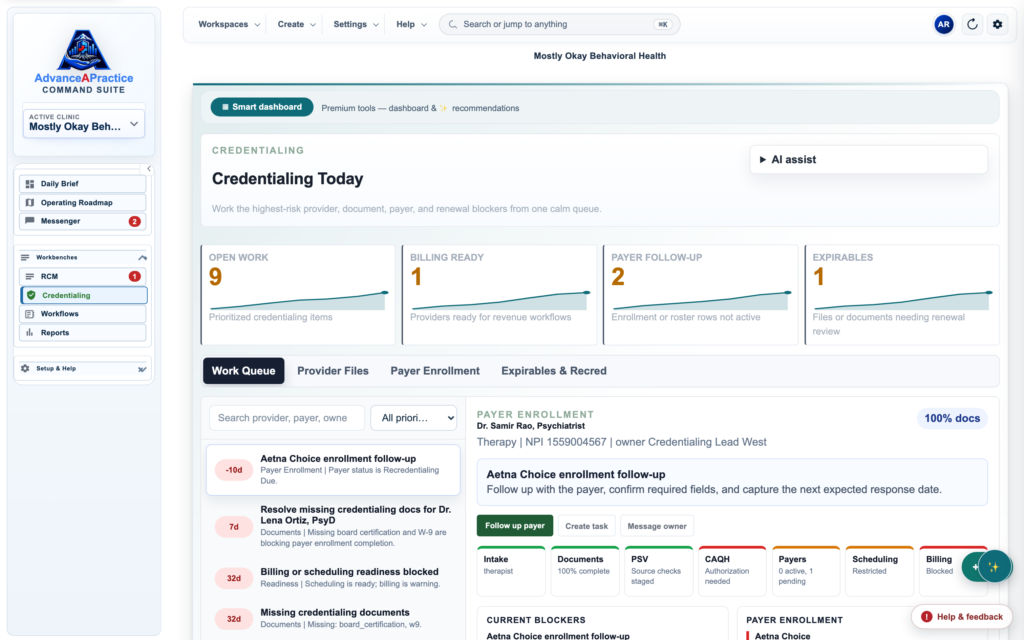
How It Works
From License To In-Network, In Three Steps
Practice Fit Call
We map your payers, states, and business structure, then gather your licenses, certifications, and history.
We Build And Submit
CAQH, PECOS, Medicaid, and commercial applications go out clean, with primary source verification handled.
We Track And Follow Up
Documented status on each panel, plus a recredentialing calendar with owners and upcoming due dates.
Timelines
Realistic Payer-By-Payer Timelines
No single national number exists, timelines depend on payer, state, and completeness. Treat these as estimates for a clean application; give a new practice three to four months of runway. See PMHNP credentialing cost and the full timeline. Medicaid is the piece that genuinely changes at the state line, see credentialing and payer enrollment by state for your state’s program and enrollment path.
Swipe or scroll horizontally to view every timeline column.
| Payer type | Where you apply | Typical clean-application window |
|---|---|---|
| DataSpring Provider Data Portal (formerly CAQH) setup | caqh.org | Days to ~2 weeks to build and attest |
| Commercial (Aetna, Cigna, UHC, BCBS) | Payer portal + CAQH | ~60 to 120 days |
| Medicare | PECOS (CMS-855I) | ~45 to 90 days |
| Medicaid | State Medicaid portal | Varies by state |
Avoid These
Where PMHNPs Lose Months
Starting Too Late
Waiting until opening can create an avoidable out-of-network period. Begin once the license and business records are ready.
Letting CAQH Lapse
A missed re-attestation can pause commercial credentialing work until the profile is current.
NPPES / PECOS Mismatches
Different names or addresses across systems can lead to Medicare rejections or avoidable rework.
Incomplete Applications
Work-history gaps or blank disclosures bounce back and add weeks per payer.
FAQ
Frequently Asked Questions
How Long Does PMHNP Credentialing Take?
There’s no fixed national number. For a clean application, commercial payers commonly take 60 to 120 days, Medicare through PECOS about 45 to 90 days, and Medicaid varies by state. Plan on three to four months of runway.
What’s The Difference Between Credentialing And Enrollment?
Credentialing verifies your license, education, and history through primary source verification. Enrollment is the contract that makes you an in-network, billable provider. You need both before claims pay.
Do I Need A CAQH Profile As A PMHNP?
For most commercial payers, yes, they pull credentialing data from DataSpring Provider Data Portal (formerly CAQH), which must be complete and attested. Re-attest every 120 days (180 in Illinois) or it expires.
Get The Free Credentialing Checklist
Payer strategy, CAQH, follow-up cadence, and post-approval steps, the same structure we use on client projects. PDF.
Informational only, general information, not legal, financial, or compliance advice. Credentialing rules, timelines, and enrollment requirements vary by payer and by state and change over time. Verify current requirements with the applicable payer, CMS, and your state agencies. Last reviewed: July 2026.