
Behavioral Health Credentialing
PMHNP Credentialing & Payer Enrollment
We prepare your PMHNP credentialing applications and follow each one to a written decision, covering your CAQH/DataSpring profile, Medicare enrollment through PECOS, your state Medicaid enrollment and each commercial payer.
Commercial credentialing starts at $1,200 total for two payers for an individual provider, $1,550 to add one provider to existing clinic contracts, or $2,000 for two contracts under your practice.
Build My Credentialing PriceSecure checkout by  Pay by card, Apple Pay or US bank account. HIPAA compliant, with a signed BAA.
Each total includes setup and two applications. Setup is $500, $750 or $1,000 per provider, and additional commercial payers are $350, $400 or $500 each, with a two payer minimum. Medicare or Medicaid enrollment is $450 each with no setup fee.
Buy online, sign your agreements in the Command Suite, and we start within three business days after we receive your completed onboarding information, documents and access.
What’s Included
Everything A PMHNP Needs To Bill In-Network
- Individual Type 1 NPI and psychiatric taxonomy, plus your practice’s Type 2 organizational NPI.
- DataSpring Provider Data Portal (formerly CAQH) information prepared and aligned; the provider personally completes each attestation. If you’d rather we update your profile for you, you can choose to share your sign-in through secure onboarding and change the password when we’re done.
- Medicare enrollment through PECOS (CMS-855I), including group reassignment, which CMS now handles on the 855I.
- State Medicaid enrollment, including states that require active Medicare first.
- Commercial networks, starting with Aetna, Evernorth Behavioral Health (Cigna), Optum Behavioral Health (UnitedHealthcare) and your state’s Blue Cross Blue Shield licensee. We’ll add Humana and Anthem/Elevance, where Carelon Behavioral Health often administers behavioral health, when they carry local volume.
- Collaborative practice and scope-of-practice rules by state, mapped to you.
- Primary source verification and application follow-up on every payer.
- A recredentialing and revalidation calendar with every upcoming due date and the person responsible for it.
Deadline Tracking
Getting In-Network Once Isn’t The End
Recredentialing runs at least every 36 months, CAQH re-attestation every 120 days, and Medicare and Medicaid revalidation every five years. We keep every payer and due date in one view, flag what’s coming up, and tell whoever’s responsible before the date arrives.
Ask Practice Concierge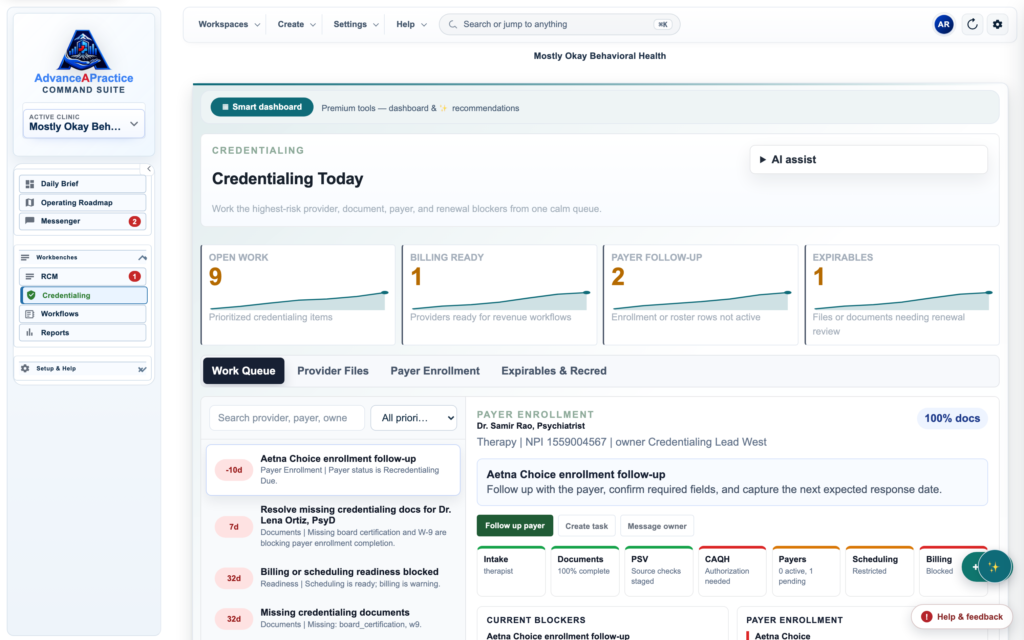
How It Works
From License To In-Network, In Three Steps
Practice Fit Call
We map your payers, states, and business structure, then gather your licenses, certifications, and history.
We Build And Submit
Your CAQH, PECOS, Medicaid and commercial applications go out complete, with the same name and address on every one, and we handle primary source verification.
We Track And Follow Up
You can see where each panel stands, and you get a recredentialing calendar with every upcoming due date and who’s handling it.
Timelines
Realistic Payer By Payer Timelines
There’s no single national number. Timelines depend on the payer, the state and how complete the application is. Treat these as estimates for a clean application, and give a new practice three to four months of runway. See PMHNP credentialing cost and the full timeline. Medicaid is the piece that changes at the state line. See credentialing and payer enrollment by state for your state’s program and enrollment path.
Swipe or scroll horizontally to view every timeline column.
| Payer type | Where you apply | Typical clean application window |
|---|---|---|
| DataSpring Provider Data Portal (formerly CAQH) setup | caqh.org | Days to ~2 weeks to build and attest |
| Commercial (Aetna, Evernorth/Cigna, Optum/UnitedHealthcare, your state’s Blue plan) | Insurance portal + CAQH/DataSpring | ~60 to 120 days |
| Medicare | PECOS (CMS-855I) | ~45 to 90 days |
| Medicaid | State Medicaid portal | Varies by state |
Avoid These
Where PMHNPs Lose Months
Starting Too Late
If you wait until opening day to start, you can end up seeing patients before any payer has given you an effective date. Start as soon as the license and business records are ready.
Letting CAQH Lapse
Miss a re-attestation and commercial payers can stop working your application until the profile is current again.
NPPES / PECOS Mismatches
If your name or practice address reads one way in NPPES and another way in PECOS, Medicare can reject the application, and you file it all over again.
Incomplete Applications
Work history gaps or blank disclosures bounce back and add weeks per payer.
FAQ
Frequently Asked Questions
How Long Does PMHNP Credentialing Take?
There’s no fixed national number. For a clean application, commercial payers commonly take 60 to 120 days, Medicare through PECOS about 45 to 90 days, and Medicaid varies by state. Plan on three to four months of runway.
What’s The Difference Between Credentialing And Enrollment?
Credentialing verifies your license, education, and history through primary source verification. Enrollment is the contract that makes you an in-network, billable provider. You need both before claims pay.
Do I Need A CAQH Profile As A PMHNP?
Yes, for most commercial payers. They pull credentialing data from the DataSpring Provider Data Portal (formerly CAQH), and your profile has to be complete and attested. Re-attest every 120 days (180 in Illinois) or it expires.
The Behavioral Health Credentialing Checklist
Five pages: every document payers ask for, the CAQH/DataSpring steps that stall files, how to pick payers, a renewal calendar and a payer tracker you can fill in. We email it to you right away.
This is general information. It isn’t legal, financial or compliance advice. Credentialing rules and timelines differ by payer and by state, and they change. So do enrollment requirements. Before you act on anything here, check it with the payer and your state agencies, and with CMS. Last reviewed: October 25, 2026.
Choose The Right Credentialing Path
Opening a practice, adding a provider, moving existing payer relationships, and seeking new contracts require different work. See the price and scope that match your situation.