
Spravato Operations Series
Starting A Spravato Program: The Operational Launch Checklist
Payer credentialing comes first, because it commonly runs 60 to 120 days per payer. Then you certify the site in the SPRAVATO REMS, choose buy-and-bill or specialty pharmacy, staff the two-hour monitoring window and build a schedule that holds induction slots. Plan on roughly three to six months from decision to first session.
A Reliable Spravato Program Starts Months Before The First Appointment
Deciding to offer Spravato (esketamine) is the easy part. What comes after is a project plan with real lead times, because a program that’s certified, contracted, staffed, scheduled and solvent takes coordinated work, and several of the longest items can’t be compressed. Programs that launch smoothly do the slow things first, so payer enrollment and REMS certification start months before the first patient’s first session. The ones that struggle announce a start date and find out about the lead times afterward.
Here’s the launch sequence we use. It comes from supporting a roughly 70-patient interventional psychiatry program in Oregon that runs 12 to 15 sessions a day.
1. REMS Certification And Enrollment Infrastructure
The healthcare setting has to be certified in the SPRAVATO REMS before it can receive or administer drug. That’s a facility-level enrollment, separate from anything the prescriber holds individually. Complete the outpatient healthcare setting enrollment, designate an authorized representative, train the staff who’ll administer and monitor, and stock the required monitoring equipment (blood pressure monitoring and, per current requirements, a pulse oximeter). Put patient REMS enrollment in your intake packet from day one so it never turns into a day-of-treatment scramble. The requirements get updated periodically, so verify the current state at spravatorems.com, and read our REMS compliance workflow for how they translate into daily operations.
2. Payer Contracting And Credentialing: Start This First Because It Takes Longest
Spravato revenue rides on payer participation: prescriber credentialing, facility enrollment where applicable, and confirmation that your contracts actually cover the codes you intend to bill. Credentialing and enrollment commonly run 60 to 120 days per payer, and a new service line won’t make it go any faster. Map the payers that matter in your market, verify their esketamine policies (medical vs. pharmacy benefit, site-of-care rules, PA criteria), and start enrollment before you sign a drug distributor agreement. A REMS-certified clinic with no in-network payers is a very expensive waiting room. Our credentialing timeline guide covers what slows enrollment down.
3. The Drug Acquisition Decision: Buy-And-Bill Vs. Specialty Pharmacy
Buy-And-Bill
You buy drug from an authorized specialty distributor, hold the inventory, and bill the payer’s medical benefit alongside the administration. The upside is on-demand inventory and scheduling flexibility, so a same-week induction is possible. The downside: the drug cost sits on your balance sheet, and an unpaid claim means you ate the drug. That’s why benefit verification and auth tracking have to be airtight first.
Specialty Pharmacy (White-Bagging)
A REMS-certified specialty pharmacy bills the patient’s pharmacy benefit and ships patient-labeled drug to your clinic for each session. Upside: no inventory capital and no carrying risk. Downside: every appointment now depends on a shipment. Reschedules, benefit changes and shipping misses all land on your calendar, and patient-labeled product generally can’t be used for anyone else.
Reality: Most Programs Run Both
Payer benefit design usually picks the pathway for each patient. Your preference doesn’t get much say. Plan for a hybrid from the start: two intake workflows, two billing patterns and a scheduling system that knows which pathway each patient is on.
4. Space, Staffing, And The Monitoring Model
Every session requires at least two hours of post-dose monitoring by a healthcare provider on-site, so capacity is a physical design question: how many monitored rooms, covered by how many staff, for how many hours a day. Practical planning points:
- Rooms: Calm, low-stimulation spaces with recliners; patients experiencing dissociation don’t belong in a bright open bay next to intake.
- Monitoring coverage: A nurse or equivalent healthcare provider covering a defined number of concurrent rooms, with vitals cadence (blood pressure, pulse oximetry) built into a flowsheet; prescriber available per protocol and state rules.
- Throughput math: sessions/day ≈ rooms × staffed hours ÷ ~2.5. Fifteen sessions a day on a 7am to 7pm window takes roughly four concurrent monitored rooms. That’s a staffing budget line, and you decide it before launch, not after the waitlist forms.
- Ride-home logistics: Patients can’t drive until the next day, so make ride confirmation a required scheduling field.
5. The Scheduling Template: Induction Is A Different Animal Than Maintenance
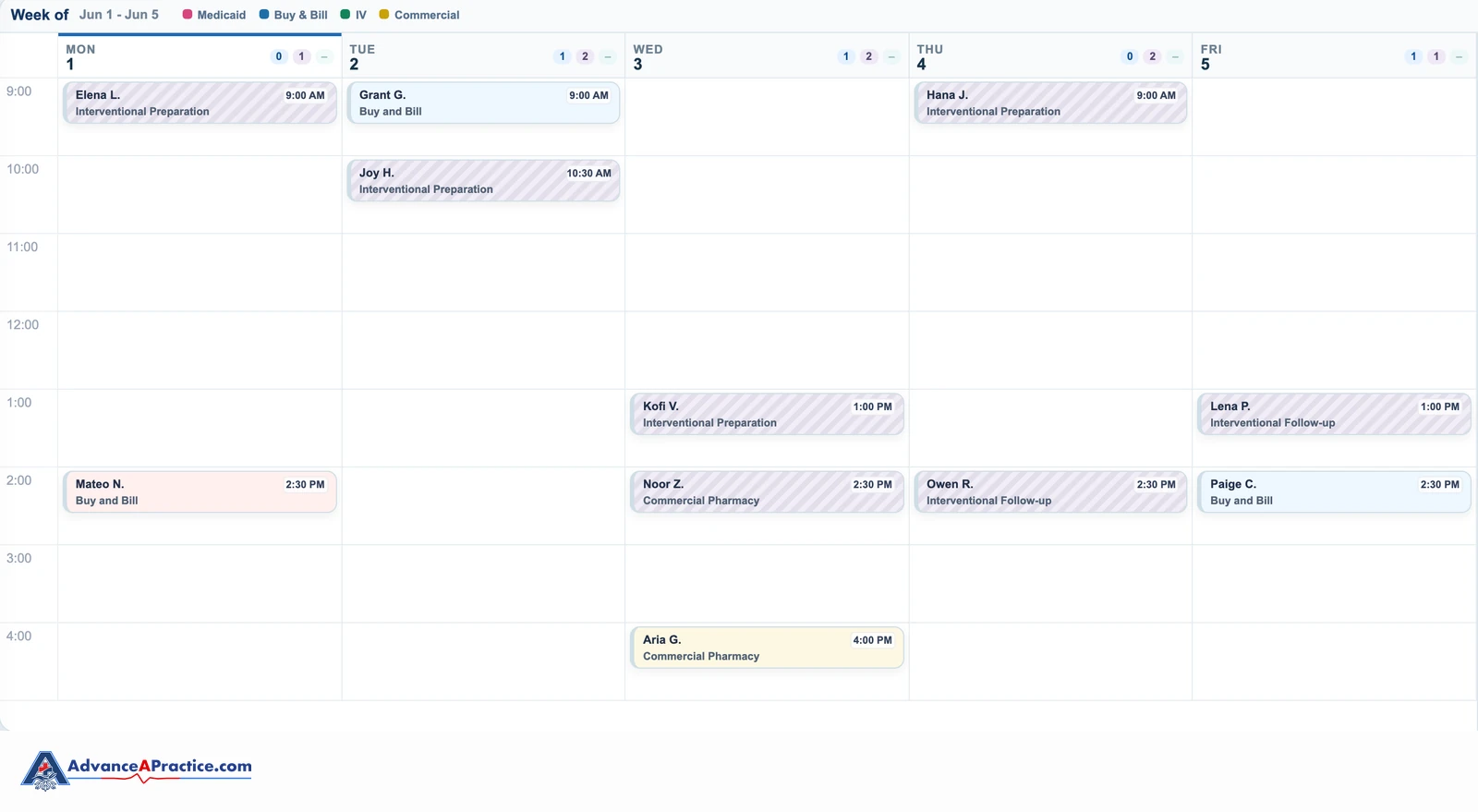
The labeled schedule runs twice weekly in weeks 1 to 4, weekly in weeks 5 to 8, then every one to two weeks. So every new patient takes eight induction slots in their first month, and progressively fewer after that. Two things follow for your template:
- Reserve induction capacity. If maintenance patients fill every slot, you can’t start new patients, and the program stops growing. Hold dedicated induction blocks (e.g., fixed morning pairs on Monday/Thursday and Tuesday/Friday) so twice-weekly cadences can actually be booked as pairs.
- Book the whole series, not one visit. Schedule the full induction arc at intake and track adherence to it, because payers read big schedule gaps as a medical-necessity question at reauthorization. A live view of every patient’s schedule is one of the most valuable tools a program can have. The interventional psychiatry scheduler on our custom software and automation page (there’s a demo video) was built for exactly this.
6. Financial Model Basics
Model the program before launch with honest inputs: drug acquisition cost per session under buy-and-bill versus zero drug capital under white-bagging; expected reimbursement per session by payer (Medicare’s bundled G2082/G2083 versus commercial drug-plus-services patterns; see the billing guide); staff cost per monitored hour; realistic ramp (a program’s first quarter is induction-heavy and capacity-light); and a no-show/cancellation assumption, because each missed slot is a 2.5-hour block and, on the pharmacy pathway, possibly a stranded shipment. The model doesn’t need to be fancy. It needs to tell you your break-even sessions per day and how many days of auth-lapse leakage would erase your margin, because that number is usually smaller than owners expect. Once claims start going out, our Spravato billing services match the units to the dose in each note and keep working those claims every month.
Common Launch Mistakes
Certifying Before Contracting
REMS certification takes weeks; payer enrollment takes months. Teams that do them in that order launch with a certified site and no way to get paid.
No Authorization Tracking From Day One
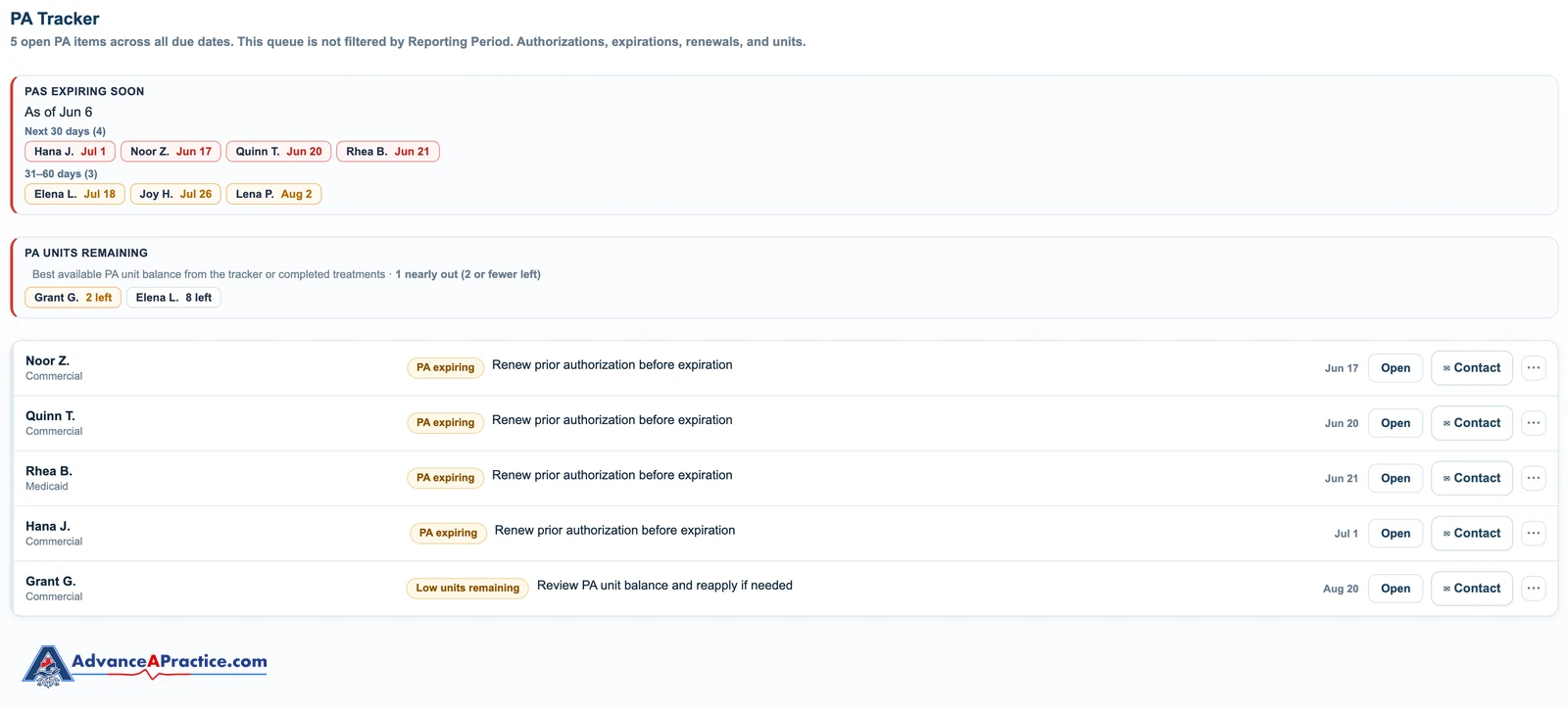
At five patients you can remember the auth dates. At forty you can’t, and the failure shows up silently. Build the tracker before you need it (see authorization tracking).
Underpricing The Two-Hour Session
Programs that model Spravato like a med-management visit discover their staffing cost per session too late. The monitoring window is the cost center; model it explicitly.
Treating Benefit Verification As Optional
Verify the pathway (medical vs. pharmacy benefit), patient responsibility and PA requirements for every patient, in writing, before induction. Otherwise the first denial becomes the program’s tuition payment.
Common Questions
How Long Does It Take To Launch A Spravato Program?
Plan on roughly three to six months for the whole launch. REMS setting certification and staff training take weeks, but payer credentialing and enrollment are the long pole, commonly 60 to 120 days per payer, which is why contracting starts first.
What Equipment Does A Spravato Clinic Need?
Less than you’d think, but it’s specific: comfortable low-stimulation treatment spaces, blood pressure monitoring, a pulse oximeter (required under current REMS provisions), emergency protocols, and secure drug storage if you run buy-and-bill. The larger investment is staffing the monitoring window, not equipment.
Should A New Program Choose Buy-And-Bill Or Specialty Pharmacy?
Usually you don’t get to choose for the whole program. Each payer’s benefit design tends to dictate the pathway patient by patient. Decide which pathway you prefer when both are possible, and build workflows for both from day one.
How Many Patients Does A Spravato Program Need To Be Viable?
It depends on payer mix, reimbursement, and staffing cost, which is why the pre-launch financial model matters. The structural point is that induction patients consume eight slots in month one, so model capacity and break-even in sessions per day, not patient counts.
Can A PMHNP-Owned Practice Launch A Spravato Program?
In many states, yes, subject to scope-of-practice and payer enrollment rules. The REMS certifies the setting, and prescribing authority follows state law. See our PMHNP hub for state-by-state practice requirements.
Launching Spravato, TMS Or Ketamine?
Two items on this checklist decide whether a program stays funded after launch: the schedule and the authorization tracker. An Automation Program builds that workflow into the systems your team already uses, from room and observation-time scheduling to authorization and REMS tracking. It’s $5,000, or 5 monthly payments of $1,000. For the claims, see our billing prices by practice size.